|
|
|

|
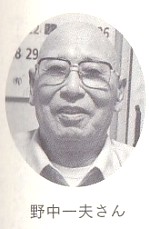
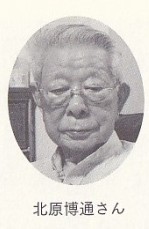
Hiromichi Kitahara (left) and
Kazuo Nonaka (right)
|
|
|
Military Record: Both Enlistment and War's End in Kagoshima (Gunreki: Nyūtai
mo shūsen mo Kagoshima)
Researched and written by Shūji Fukano and Fusako Kadota
Pages 270-272 of Tokkō kono chi yori: Kagoshima shutsugeki no kiroku
(Special attacks from this land: Record of Kagoshima sorties)
Minaminippon Shinbunsha, 2016
"Enlistment in the Yokaren (Navy's Preparatory Flight Training Program),
flying trainers, and on standby for a special (suicide) attack all were at air
bases in Kagoshima Prefecture. My military record was inseparable from
Kagoshima."
The man saying this is former Navy Flight Petty Officer 2nd Class Hiromichi Kitahara
(88 years old, Dazaifu City, Fukuoka City). He was a member of the Kamikaze
Special Attack Corps Hikari Unit, which was stationed for about a month from the
middle of July 1945 at Kokubu No. 2 Naval Air Base near where Kagoshima Airport
is currently located. The Hikari Unit flew Type 93 Intermediate Trainers
(nicknamed Akatonbo or Red Dragonfly).
In October 1943, Kitahara, who grew up in Nōgata City in Fukuoka Prefecture,
volunteered for the Yokaren's 13th Kō Class and entered the Navy at Kagoshima
Air Group in Kagoshima City. In July 1944, he transferred with about 250
classmates to the training air unit at Izumi Naval Air Group in Izumi City and
started the training program to fly Type 93 Intermediate Trainers.
In March 1945 before the Battle of Okinawa, operational aircraft such as
Ginga attack aircraft (Allied code name of Frances) began to advance to Izumi
Air Base. The Izumi Naval Air Group moved from Izumi Base to Kōshū (Gwangju in
Korean) Naval Air Base in Choruranamudo, Korea, and became the Kōshū Naval Air
Group.
Moreover, in May 1945, a special attack unit, which was made up of training officers
and the 13th Kō Class, was formed.
As for the training at Kōshū, "it was focused on nighttime flying in
formation." Intermediate Trainers were slow, so daytime special attacks would
have been difficult. It was decided that if American war boats came at night to
land on beaches in southern Kyūshū, formations of three planes each would dive into
them.
In July 1945, the Hikari Unit was ordered to advance again to Kyūshū. Four
squadrons of 36 aircraft each were deployed and distributed between three bases:
Kokubu No. 2 (Kagoshima Prefecture), Ōmura (Nagasaki Prefecture), and
Isahaya (Nagasaki Prefecture).
Kitahara's classmate Kazuo Nonaka (88 years old, now lives in Isa City in
Kagoshima Prefecture) was
stationed at Isahaya Base. He testifies, "Even though the base was in Nagasaki,
the place where I would crash in a special attack was determined to be at
Fukiage Beach (Kagoshima Prefecture)."
Kitahara, who advanced to Kokubu No. 2 Base as a member of the 1st Squadron
made up of 36 aircraft, cannot forget that they avoided fierce air attacks
for several days by carrying the planes over 20 kilometers from base. "We
first did the tail of an Intermediate Trainer after the wings had been removed.
We concentrated all of our efforts to push it forward. It was hard work."
Also, there he faced the end of the war on August 15. During the following
morning on the 16th, Kitahara was informed by the base commander of the defeat.
Due to the huge shock, Kitahara's memory of the time until he departed the base
is vague, and he only remembers clearly the scene when the base commander made
an inquiry of the men.
"Five years after Germany lost World War I, it became a strong country that
again went to war against other nations. Since the Empire of Japan had bad
fortune in this war, many officers have the motivation to rise again. If there
are men here with such motivation, please raise your hand." The commander
expressed his thanks to Kitahara and others who raised their hands, and he
departed.
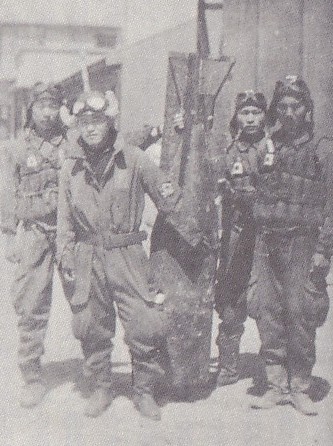
Hikari Unit members with 250-kg bomb
to be
loaded on Type 93 Intermediate
Trainer.
Hiromichi Kitahara is on far left.
(provided by Kitahara)
Translated by Bill Gordon
August 2026
HOME >
Stories > Military Record: Both Enlistment and War's
End in Kagoshima
|
|
